
What is Shamanic Journeying?
a non-comprehensive answer to the material i teach
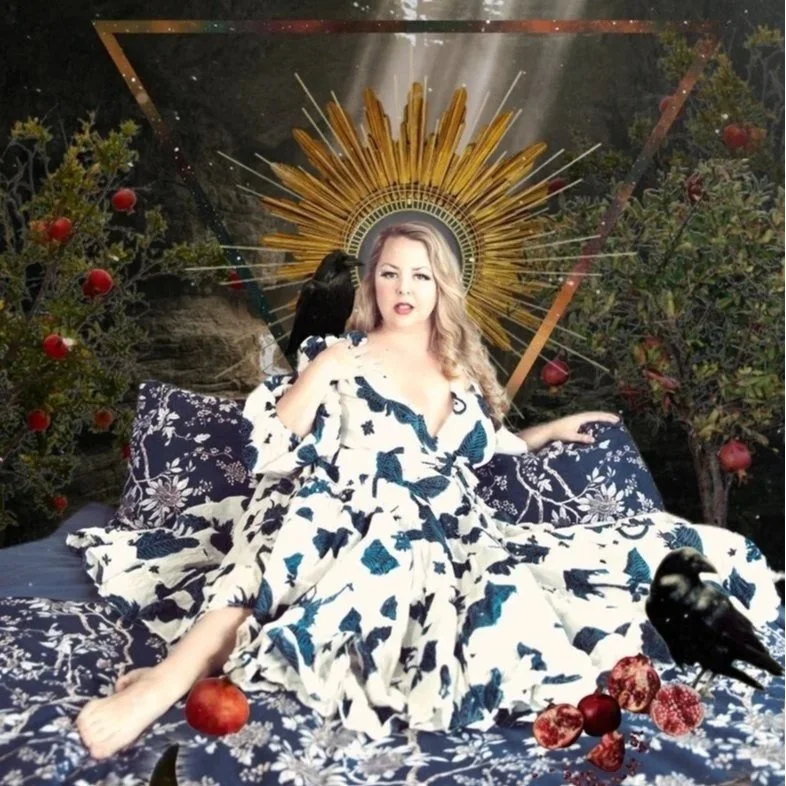
Someday I might figure out how to edit, but today is not that day. You get to hear all my smoker’s coughs(I smoke weed like Snoop) and ADHD/perimenopause brain verbal side quests. Frankly, I’m here for it.
As I said last time, this isn’t a bloody podcast. These are voice notes to friends. Meaning YOU.
You wanna be friends?
Access the Voice Note Here:
This article was originally published on Substack. You can read the original here.
Audio Transcription:
So, what is shamanic journeying, anyway?
If you subscribe to my page, if you've read any of the stuff that I have written in the past or, you know, looked at any of my posts, you see that I'm talking about shamanic journeying often. And at the end of the year, I host a training course for how to do shamanic journeying.
Shamanic journeying actually has a myriad of names, and there are different ways in different cultures from different teachers that you can embrace this task, I guess, if we could call it, this practice. To me, it is part of the technology that is inherent in our human form. And it is how we are, to quote the Bible, of all things. It is how we are created in God's image. It's how we can utilize all of our implicit skills to co-create, to frolic in the quantum foam and co-create this life of ours, the reality that we see externally.
Carl Jung embraced a process like this that was very similar. In many ways, it is the same thing, and of course, from indigenous perspectives, it's vastly different. So his process was, what did he call it, active imagining. And so he had this pantheon of figures that would sit on his desk, and they were archetypes for him, and he would have conversations, and they would respond to him.
In some ways, there is a somatic psychological practice called part's work. The journey is also very similar to that, although, again, not the same.
So I was taught by Hank Wesselman and Jill Kirkendall, and they were very good friends with Halle Makua in the 90s and early aughts. So Hank and Jill, Hank had started having these out-of-body experiences, these ecstatic moments, and he was a trained scientist, and he was like, okay, what's happening, am I going crazy? So he started doing some investigation, and then he stumbled across this guy, Michael Harner, and Michael Harner, in essence, taught a bunch of white people how to do this process, which we had forgotten, and actually violently, willfully forgotten, but I won't go into that in this voice note.
So they first learned how to do the shamanic journey and practice process through Michael Harner. They met a woman named Sandra Ingerman, who's written a bunch of books about this stuff, and then they met Halle Makua, and spent the rest of their years together with him. So in the Hawaiian mystic traditions, as far as they have been taught to me, now please, if you are more deeply steeped, and I'm getting it wrong, just let me know, and I will correct, I will course correct.
So as taught to me by Hank, what happens in this process of shamanic journey is that we're using a steady drumbeat or a rattle, and the mechanistic process that's happening in our brain is that right now, we're engaged at, I believe, it would be a gamma level right there about where our brain is active, we're paying attention, we're listening to each other, we're in conversation.
And then the steady drumbeat or rattle shake helps to bring the brainwave level down between the alpha to theta state, and this is the state that we're at in REM sleep while watching, you know, engaged in watching TV, if you're not ADD and doing 10 other things, while the TV just happens to be on.
And then also under hypnosis, you know, as a side note, some people think that hypnosis is for really stupid people, or that it's a panacea, or, you know, that there's something, I don't know, magical about it, and honestly, it's not, I worked at a hypnotherapy clinic for a little over a year, and the research that was presented there was that actually, it's very stupid people who cannot be hypnotized, so if your IQ is lower than like 82, you just can't take to the hypnosis.
And also, while under hypnosis, you should never actually just be blacking out, your conscious mind will always be slightly engaged, you'll know what's happening, and you have the free will and the choice to override the powerful suggestions. If you do want to undergo hypnosis also, it's just way more effective for you to voice your own tapes.
Now I'm getting down a really long rabbit hole on hypnosis, we don't need to go there. We're talking about shamanic journey.
Okay, so we're listening to that steady drum beat, or the shake of the rattle, and it's not like you're at some Santa Cruz hippie drumming ceremony on the beach, man. It's just a steady drum beat, so very much like if you've ever attended a powwow or listened to traditional indigenous music, it's also, by the way, what makes pop music so popular is that it mimics the steady beat of our heart, the heartbeat of the mother also.
The planet has a heartbeat, so we're just beating the drum or shaking the rattle, and that drum beat, and then it helps to bring those brainwave levels down so that the limbic system can relax.
In these Hawaiian traditions, the mystic traditions, what happens is that the linear mind, the creative mind, frankly, associated with the lono aspect of the soul. Again, if I'm getting it wrong, you just let me know. This is how I learned it. That part gets to take a step back and just sit in the passenger seat.
Meanwhile, the coup gets to come forward, and I always refer to the coup as the fightman fucking side of our soul. It's the perceiving side, but it's the side that loves its ice cream cone and loves a velvet blanket and warm flannel sheets next to a fire on a cold winter's day. It likes the hot mug of cocoa.
I think I'm fantasizing about the fall because it's San Francisco in the summertime, so it's like 55 degrees and cold and drizzly, and I've got fantasies about the upcoming Burr month, so you get what I mean, though. The coup. Let's see. It's a summer's day. Maybe it wants to go right away or take a hike down the river and peel off those clothes and go skinny dipping in the clear creek. That's the coup. Oh my gosh, excuse me.
All right, so that's the active part of our soul that is present, mainly during shamanic journeying, the perceiver. So there is, when we go on a shamanic journey, we set our intentions for what that journey is. Maybe there's a question we'd like to ask. Maybe we just want to go hang out.
I keep sharing with all my clients that shamanic journeying is really about building relationship. So people sometimes get into this work because they are seeking healing. Sometimes they get into it because they want to amplify their magic abilities and their personal power, which, you know, buyer beware, I think.
What we're really doing, though, is, yeah, yeah, you can do all that stuff. Sure, all of that stuff is available. Absolutely. But it comes at the cost of relationship. So whatever it takes for you to build solid, loving relationships in your waking life, that is exactly what it takes to build relationships in the dream time. We, you know, depending on what you want from the relationship, it would behoove us to make the time, make the time in our schedules to go on the journeys to engage.
And then, you know, if you're asking for things from your team, make sure that you're bringing something to the table as well, right? It's always a good thing to bring a hostess gift, right? If you got invited to a party or a dinner somewhere, bring a little something to the host to say thank you. I see you. I appreciate you. Thank you for the invitation. Thank you for putting your work and your effort into this event and that I get to be present at it.
It's really the same when you're, when you're working with your team, let's say you want to go and really start building relationship with Hecate, the goddess of the crossroads. Well, if you're going to ask her for things, even if it's just knowledge, take a broad out to lunch, would you? You know, bring her a little necklace, a little trinket, something, you know, a birer glass of wine, hard boil some eggs, who knows, you know, milk the fucking cow, skim the cream off the top and bring it to the fairies. It's a small price to pay, I promise.
So that's a little bit of what shamanic journeying is. It is in some ways delving into our unconscious, our subconscious, into the depths of our own psychology. And I, you can stop there if you, if that's, you know, where you're at.
For me though, I genuinely do believe that we are interacting with thought forms, archetypes, only even the stones and the birds and the, you know, any of the beings who we end up engaging with, I do believe that there is a genuine interaction occurring, that it's not all just in our mind and in our, in our imagination. So that's why in large part I differ with the Jungian theory of what's happening is like, I'm not creating all of this stuff.
So I will go into the middle world of dream and I will tend to my personal garden space. You know, I've got a, I've got a home dwelling structure there, I've got the gardens, I've got all of these little portals to other realms that I am building relationship with. And there will be aspects that I want to implement in there. And so I'll work on it for a journey and maybe it even sticks for that journey, but I'll come back next time and it's not there anymore.
Like there was, for a long time, when I first started journeying 25 years ago, excuse me, I went to a, oh, I went to a workshop with Hank and Jill at Esalen in 2001, the summer of 2001. Oh my gosh, I hope I don't get sidetracked by my own, my brain's own side quest.
So how he trained us is that we would, you know, pick a spot in nature that we really connect with in the waking world. And then in our minds, I find a whole, maybe it's a hole in the ground, maybe it's a, like a, an open knot in the side of a tree, excuse me, oh, you're really, it's giving Alice in Wonderland, right? So you go into the, in through that door, in through the mirror, in through the hole, whatever, whatever space you find, and you descend into the middle world.
And there you meet up with your allies and, you know, you can, you can travel to various other places. But what you're really looking for initially is like your personal dwelling space. And for a long time for me, it was this very witchy house in a tree. When I was growing up, my aunt had a beautiful poster that was like dark and sinister, but also just gorgeous, the very fantasy like of this tree in the forest that was a home. And so this place in my middle world of dream and my secret garden in my shamanic journey was basically that treehouse.
And then one day that wasn't my space anymore. I had been moved without my knowledge until I came back to visit. It was like that was a cold, unwelcoming space that was no longer my home, and I was taken to this place that was my new home. So there is very much an element of co-creation and what we discover is that when things change in the dream time, they also change in your waking life.
So one of my mentors, Jill Kurgendall, she tended to a beautiful garden in her middle world of dream. And then one day there was a horrible storm that decimated everything in that middle world space. And things really changed in her outer life. That was the time, if I'm not mistaken, that they moved from the mainland to the islands. And so it wasn't a bad thing. It was just a time of incredible upheaval. And they were fulfilling parts of their destiny, Hank and Jill, in doing that. If you've ever read any of those Spirit Walker books, then you know what I'm referring to.
So let's see. This is probably not going to be a comprehensive discussion of what shamanic journey work is, but this is definitely a start. If you have any questions about this material, I could talk endlessly about it, as you can probably pick up. I love talking about it. I love talking about all things occulted in esoteric and philosophical and political and and and and.
So that is maybe the long and the short of it. Shamanic journeying is an inroad to our personal psychology. It's a way to anthropomorphize these different aspects of our being and then interact with them. And I was taught never to ask why, but because the answer to why is often why not. But to ask how and where and when and, you know, things like that, again, derailing myself with extant thoughts, speaking of anthropomorphizing, I'm watching the birds out here.
And what one really quickly begins to discover is that there actually is sentience in everything. So for me, shamanic journeying, the practice has has fortified my animist view of reality. And I do. I do think that rocks have consciousness and your car has consciousness and, you know, inanimate objects.
The author Tom Robbins writes about he writes a funny little side trip about inanimate objects in skinny legs and all. And it's quite fun for the animist in me because I I do. I mean, you know, that story is one that's tug-and-cheek. But there is an element of truth in my mind and my heart about that.
All right, well, this ramble has gone long enough. Like I said, please leave me your questions. If you want to hear me talk about anything else, you want me to leave you a voicemail about anything else, I would be so, so happy to do that. So just leave it on the comments or something. I'd love to hear from you.
All right, babes, I'll talk to you soon.